Demand for fortified beverage powders, sachets and gummies continues to grow, and with it the need for fat-soluble vitamins and carotenoids that work in water-based products. Vitamins A, D3, E and K2, along with carotenoids such as beta-carotene, lutein and lycopene, do not mix into water on their own. Formulated grades labelled CWS, CWD or beadlet are designed to close that gap.
While these labels appear on almost every specification sheet, they are often treated as interchangeable. They are not. Each describes a different property, and choosing between them is one of the earliest decisions in a vitamin or carotenoid formulation.
Solubility, Dispersibility and Physical Form Are Different Things
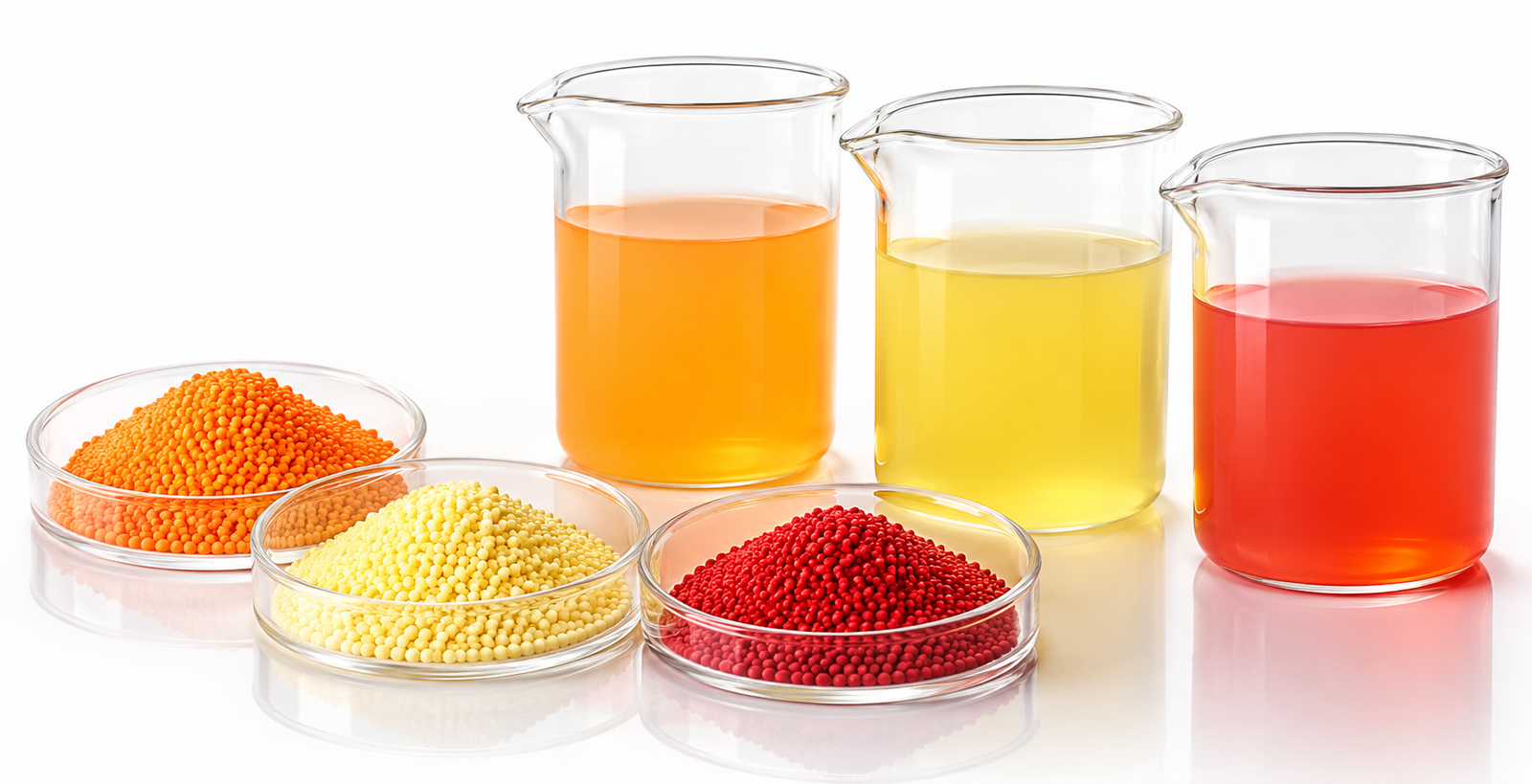
CWS stands for cold-water-soluble. It is a commercial label for grades intended to incorporate readily into cold water. For fat-soluble actives, the result is usually a fine dispersion rather than a true solution, and how clear it looks depends on the grade.
CWD stands for cold-water-dispersible. These grades spread evenly through cold water without clumping, although the result may be turbid or opaque. That is not a weakness in itself. In an opaque drink or a sachet stirred into milk, slight turbidity is rarely noticed.
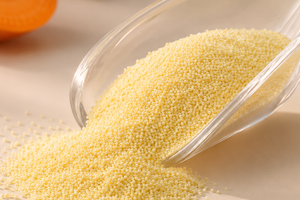
A beadlet describes physical form, not water behaviour. Beadlets are small, free-flowing particles that handle well in blending, capsule filling and tablet compression. Some are designed to disperse in water and others are not, so a beadlet can also be a CWS or CWD grade.
CWS and CWD describe what happens in water. Beadlet describes how the powder looks and handles.

Water-Soluble Vitamins Raise Different Questions
Common forms of vitamin C and vitamin B12 dissolve readily, so dispersibility is rarely the concern. The focus shifts to the active form and to stability in the finished product, since vitamin C is sensitive to oxygen and moisture and B12 to light.
Low-dose vitamins add a further challenge. Vitamins B12, D3 and K2 are often added at microgram levels, which makes even distribution through a large batch critical. Diluted grades can make this easier, but content uniformity in the finished product still needs to be confirmed.
Matching the Grade to the Finished Format
The finished format usually decides which property matters most. The table below summarises common starting points. These are considerations rather than fixed rules, as the right grade also depends on the active, its particle characteristics and the manufacturing process.
| Finished format | What matters most | What to request |
|---|---|---|
| Beverage powders and ready-to-drink | Clarity or controlled turbidity, no ring or sediment, stable colour | A CWS or CWD grade tested at the target dose in the beverage base |
| Sachets and stick packs | Fast wetting and no clumps when stirred | Dispersion time and appearance at the serving dilution |
| Tablets | Flow, compression and separation from reactive ingredients | A beadlet grade with compression and content-uniformity data |
| Hard capsules | Flow and consistent fill weight | Particle size range and bulk density |
| Gummies | Behaviour in a warm, acidic mass and colour retention | A trial in the gummy base before scale-up |
| Fortified foods | Process heat and pH | Stability data under conditions close to the process |
Why the Highest Concentration Is Not Always the Best Choice
It is tempting to compare grades on active content alone. For a target of 10 mg of active per serving:
A 5% grade requires 200 mg of powder, a 10% grade requires 100 mg and a 20% grade requires 50 mg. These figures are illustrative calculations, not product specifications.
A stronger grade saves space in a small tablet or capsule. However, it only adds value if it also disperses, blends and remains stable in the finished product. Comparing grades at the same delivered dose gives a fairer picture.
Building a Useful Specification Request
A clear request shortens development time considerably. Formulators typically benefit from sharing the following:
- Active and level: the active, its unit (IU/g or %) and the target dose per serving
- Format and behaviour: the finished format and whether a clear or turbid result is acceptable
- Conditions: processing conditions and expected shelf life
- Declarations and documents: vegan, allergen and origin statements, plus a specification sheet, certificate of analysis and safety data sheet
Testing samples in the real formulation remains essential. A grade that performs well in plain water may behave differently in a beverage that also contains minerals, acids or proteins.
Partner With IntoNaturals
At IntoNaturals, we start from the finished product rather than the catalogue label. Our Stavique™ platform focuses on ingredients sensitive to oxidation, moisture and light, including vitamin K2, vitamin D3, lutein and lycopene. Disperiq™ addresses water compatibility for beverages and powders, while Dosiq™ supports even distribution of low-dose actives.
Because performance depends on both the grade and the matrix, we confirm results with samples in each customer's own formulation. Explore our ingredient range and technology platforms.
Developing a beverage, sachet or tablet with vitamins or carotenoids? Contact our team to discuss the format and target dose, and we will suggest a grade to sample.
Contact Us →Frequently Asked Questions
Is CWS vitamin D3 dissolved in water?
Usually not in the strict sense. Vitamin D3 is fat-soluble, and most CWS grades form a fine dispersion whose clarity depends on the grade.
Can beadlets be used in beverages?
Yes, when the beadlet is designed for water dispersion. The term itself describes form rather than water behaviour.
Is CWD a lower-quality option than CWS?
Not necessarily. CWD grades suit products where some turbidity is acceptable, such as opaque drinks and sachets.
Why does a ring form at the neck of a fortified beverage?
This often points to a dispersion separating over time. Testing at the real dose and storage conditions helps identify the cause.
Do water-soluble vitamins need a CWS grade?
No. The main questions for vitamin C and B12 are stability and, for B12, dose uniformity.
Regulatory note
Permitted forms, use levels and labelling for vitamins and carotenoids vary by market and product category. This article does not establish the regulatory status of any grade.