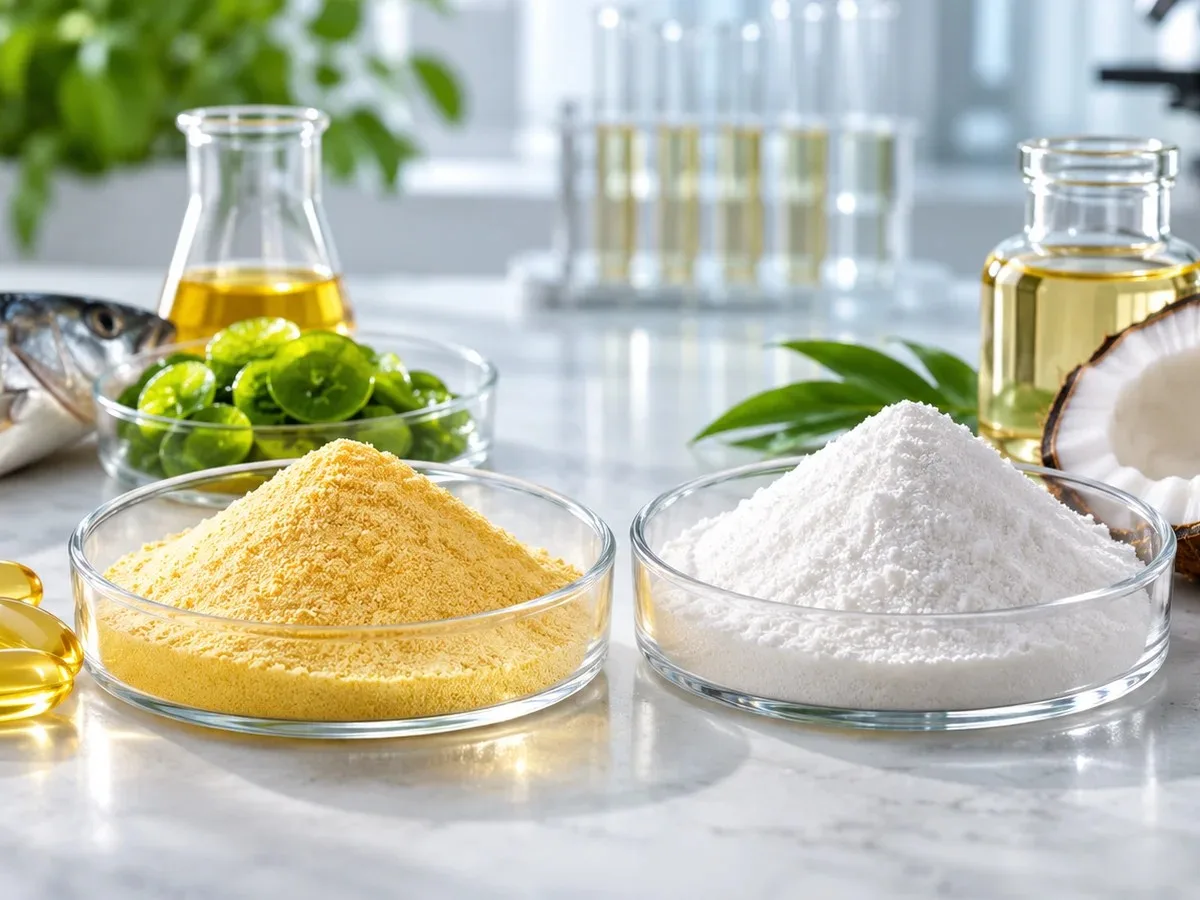
Nutraceutical formulations have become more demanding. Brands now combine several actives in a single serving, move into formats such as sachets and chewables, and sell into markets with different labelling rules. In this environment, finding an ingredient is rarely the hard part. Finding one that performs in the finished product is.
This shifts what brands need from their suppliers. Price and availability still matter, but they are no longer enough on their own. The questions below help separate a supplier that ships a powder from a partner that helps a product work.
When a Standard Grade Falls Short
The need for a development partner usually becomes clear through a problem. The following situations are illustrative rather than drawn from specific projects, but they are familiar to most formulation teams:
- Passes assay, fails in the glass: a vitamin grade meets its specification but leaves sediment in a beverage powder.
- Right potency, wrong sensory profile: a botanical extract reaches its marker level but makes a sachet too pungent to sell.
- Too much powder for the format: a low-concentration grade needs more powder per serving than a small capsule or tablet can hold.
- Same name, different behaviour: a switch to another supplier's grade of the same ingredient changes flow or blending on the production line.
In each case, the ingredient was compliant on paper. The gap lay between the specification and the finished product.
Application Fit Comes Before the Catalogue
A capable partner asks about the product before recommending a grade. Format, dose, flavour system, shelf life and target market all influence which version of an active will work. A gummy, a sachet and a tablet may each need a different grade of the same ingredient, so recommendations made before these questions are asked deserve caution.

Evidence in a Relevant Product
Data or trial results in a format close to the intended product are far more useful than results in plain water or a generic base. Claims about stability, taste or dispersibility should come with the conditions under which they were measured. Without that context, it is difficult to judge whether the result will carry over.
An Agreed Specification
An agreed specification provides the technical basis for qualifying a supplier and accepting each delivery. It usually forms part of a wider supply agreement. A sound specification states active content and tolerance, appearance, particle size where relevant, microbiology and any sensory limits, and it is agreed in writing before the first commercial order.
Samples and Documentation
Useful samples arrive in quantities large enough for a real trial, together with the documents needed to use them. Strong partners also ask for feedback, since the first sample is rarely the final grade.
Documentation deserves the same attention. A complete pack typically includes:
- A specification sheet
- A certificate of analysis for each batch
- A safety data sheet
- Allergen, vegan and origin statements
- Regulatory statements for the intended market
Certificates should be current and should cover the specific product supplied, as scope can vary by product and site.
Consistency and Willingness to Customise
Batch-to-batch consistency is where long-term supply relationships succeed or fail. A partner should be able to explain how consistency is controlled and what happens when a batch falls outside specification, without disclosing confidential details.
Standard grades cover many needs, but not all. It is worth asking whether a partner can adjust an ingredient for a particular format, dose or sensory target, and how that work is usually organised.

Partner With IntoNaturals
At IntoNaturals, custom ingredient development follows our Formiqa™ approach. It moves through five steps:
- Understand the formulation.
- Assess feasibility.
- Develop samples.
- Evaluate them together with the customer.
- Set the final specification.
The aim is an ingredient that performs in the finished product, supported by the documents needed to bring it to market. Explore our ingredients, applications and technology.
Planning a new formulation or improving an existing one? Contact our team to discuss what the ingredient needs to achieve, and we will start with a feasibility review.
Contact Us →Frequently Asked Questions
What should a first enquiry to a supplier include?
The finished format, target dose, market, and any sensory or stability problem that needs solving.
How many sample rounds are needed before a final grade?
It depends on the ingredient, the objective and what the first tests show. Agreeing the evaluation plan and acceptance criteria early helps keep the process focused.
Is the lowest price per kilogram the best comparison?
Not always. Cost per serving, plus the cost of failed trials or reformulation, often gives a clearer view.
Should certificates be checked for each product?
Yes. Certifications can apply to specific products or sites, so coverage should be confirmed for each ingredient purchased.
Regulatory note
Development work does not by itself establish the regulatory status of an ingredient in any market. A supplier certificate covers its stated scope, not every product or market.